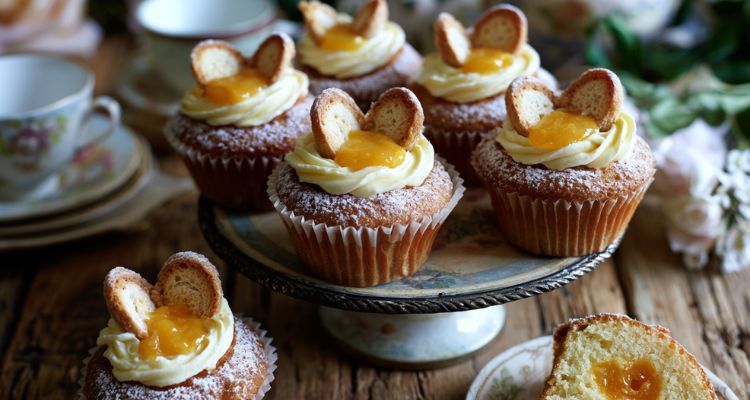
Mary Berry’s orange butterfly cakes are light sponges flavoured with orange zest, filled with orange curd, topped with buttercream wings and dusted with icing sugar, baked at 180°C (160°C fan) for 15-20 minutes. The recipe makes 12 cakes, they keep for 3-4 days in a tin, and they freeze for up to 1 month.
Berry’s headnote in Mary Berry Cooks (2014) is personal: “My granddaughter Abby made lots of these for our church sale and enjoyed weighing each one before baking to make sure they were all exactly the same size — 35g (1½oz) went into each paper case so they were all perfect and even.” That 35g tip is the most useful detail in the recipe because even-sized cakes bake at the same rate.
The technique Berry adds here that her plain butterfly cakes don’t have is the orange curd layer. After cutting the disc and before piping the buttercream, she spoons half a teaspoon of orange curd into the hollow. The curd sits hidden under the wings, so every bite has a sharp citrus burst that cuts through the sweet buttercream above.
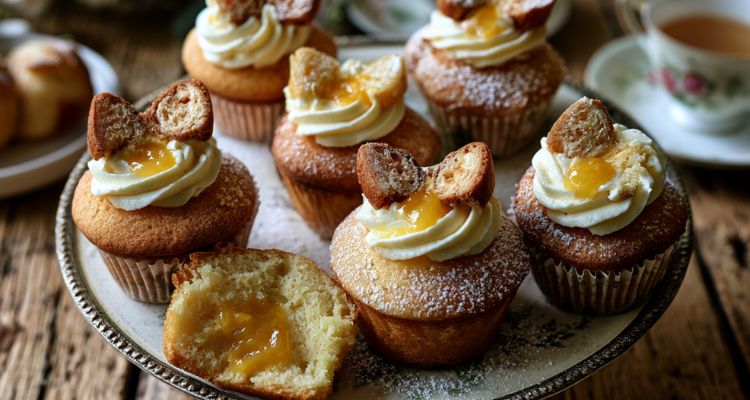
Mary Berry Orange Butterfly Cakes
Course: DessertCuisine: BritishDifficulty: Easy12
servings20
minutes15
minutes200
kcal20
minutesFrom Mary Berry Cooks (2014), an orange-zested fairy cake filled with orange curd and topped with buttercream wings. Berry’s granddaughter Abby weighed each one at 35g per case for perfectly even results.
Ingredients
- For the cakes:
100g (4 oz) self-raising flour
100g (4 oz) caster sugar
2 eggs
100g (4 oz) baking spread
1 level teaspoon baking powder
grated zest of 1 orange
- For the filling and icing:
3 tablespoons orange curd
50g (2 oz) softened butter
100g (4 oz) icing sugar, sifted, plus extra to finish
Directions
- Prepare: Preheat the oven to 180°C/160°C fan/Gas 4 (350°F). Line a bun tin with 12 fairy cake cases.
- Mix: Measure all the cake ingredients except the orange curd into a large bowl and beat well for 2-3 minutes until the mixture is well blended and smooth. Fill each paper case with 35g (1½ oz) of mixture.
- Bake: Bake for 15-20 minutes until the cakes are well risen and golden brown. Lift the paper cases out of the tin and cool the cakes on a wire rack.
- Fill with curd: When cool, cut a disc from the top of each cake, leaving a little rim around the edge, and cut this disc in half. Spoon half a teaspoon of orange curd over each cake.
- Ice and assemble: Beat the butter and icing sugar together until well blended. Pipe or spoon a swirl of the icing on top of the orange curd and place the half slices of cake on top to resemble butterfly wings. Dust the cakes with icing sugar to finish.
Notes
- Calories: Sponge: 100g spread (717) + 100g sugar (387) + 2 eggs (156) + 100g flour (345) + zest (5) = 1,610. Filling: 3 tbsp curd (135). Icing: 50g butter (359) + 100g icing sugar (394) = 753. Total: 2,498 ÷ 12 = 208 → rounded to 200 kcal per cake
FAQs
Can I use lemon instead of orange?
Berry says yes in her Mary’s Wise Words note: “You can of course also make these with lemon zest and lemon curd if preferred.” Swap the orange zest for lemon zest and the orange curd for lemon curd. Everything else stays the same, including the quantities and timing.
Lemon gives a sharper, more intense citrus hit than orange. I’ve made both and the lemon version is better with afternoon tea because the tartness pairs well with a cup of strong English breakfast. The orange version is gentler and children tend to prefer it.
What is the difference between these and the plain butterfly cakes?
Berry’s plain Butterfly Cakes in the Ultimate Cake Book (2003) use the same base sponge but without citrus zest, no curd filling, and twice the buttercream: 175g butter and 350g icing sugar compared to 50g butter and 100g here. The plain version is all about the buttercream. This orange version layers three flavours: zested sponge, curd filling and light buttercream.
The orange version also makes 12 rather than 18, with 35g per case instead of half-filling. Berry’s later recipe is more precise, which reflects her shift toward metric accuracy in her 2010s books compared to the looser imperial measurements of 2003.
Why does Berry specify bun tins, not muffin tins?
Berry is clear about this in her Mary’s Wise Words note: “Fairy cakes are not as deep as cupcakes or muffins so use shallower cake trays (widely known as bun tins) and make sure you buy the right paper cases to fill the tin.” Muffin tins are deeper and wider, so the same amount of batter would spread thin at the bottom rather than rising to fill the case.
Bun tins have shallower, slightly angled holes that give fairy cakes their characteristic flat-topped shape. The paper cases are smaller too. If you only have muffin tins, the cakes will bake fine but they’ll look like short cupcakes rather than proper fairy cakes.
How long will these keep?
Berry gives a clear storage note: “The cakes will keep in a cake tin for up to 3-4 days” and “the cakes can be frozen for up to 1 month.” The plain fairy cakes have no storage note at all, so the orange curd and buttercream clearly help seal moisture into the sponge.
Keep them in a single layer in an airtight tin so the wings don’t get crushed. If you’re freezing them, freeze before assembling the wings. Defrost the sponges, then fill with curd, pipe the buttercream and add the wings on the day you serve them.
Why does Berry weigh each portion at exactly 35g?
Berry’s granddaughter Abby weighed 35g into each case for the church sale, and Berry includes this tip because even-sized cakes bake evenly. If one case has 25g and another has 45g, the small one overbakes while the large one stays raw in the centre. At 15-20 minutes in the oven, there’s no margin for error with small cakes.
I use a digital kitchen scale and a teaspoon to portion the batter. It adds 2 minutes to the prep but every cake comes out the same height and colour. Berry’s tip here is one of those quiet details that separates a neat batch from an uneven one.