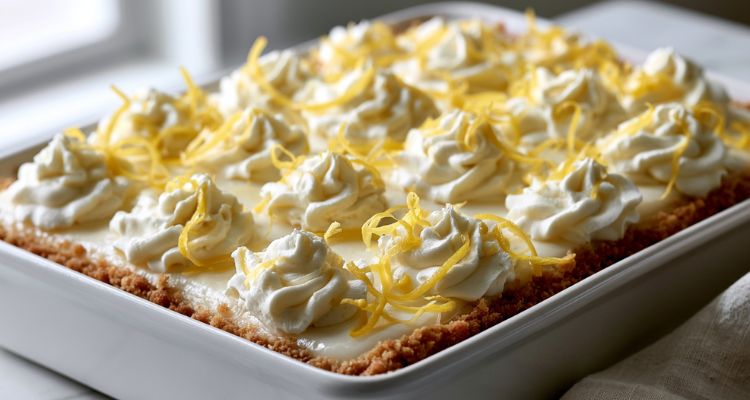
Mary Berry’s sharp lemon cheesecake is a no-bake dessert set with lemon jelly, made with soft cheese, caster sugar and whipped cream on a Hob Nob base. It chills in a 20cm (8 in) tin and serves 8.
Berry calls this “a very smooth, fresh cheesecake” and “the second easiest to make” in the Ultimate Cake Book (2003). Lemon jelly does the setting work, so there’s no fiddling with powdered gelatine. It’s lighter than her condensed milk version because whipped cream is folded through.
Getting the jelly to the right consistency before mixing is the step that matters most. Berry dissolves the jelly in boiling water, tops it up with lemon juice and then chills it until “thick and nearly set.” Add it too early while still liquid and the filling won’t hold. Wait too long and it forms lumps.
Mary Berry Sharp Lemon Cheesecake
Course: DessertCuisine: BritishDifficulty: Easy8
servings20
minutes415
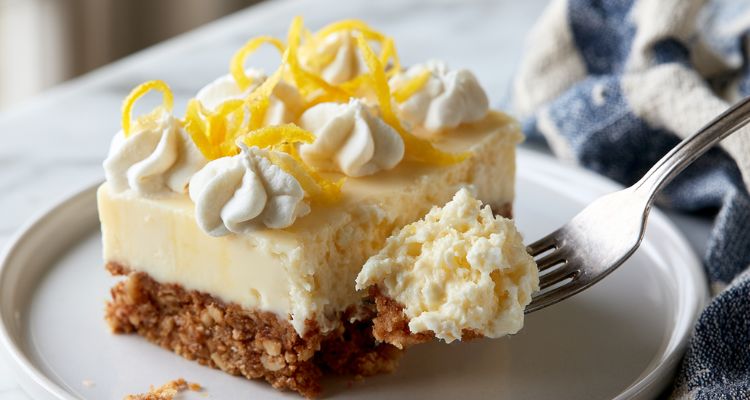
kcalBerry’s jelly-set lemon cheesecake from the Ultimate Cake Book (2003). Built on a coarse Hob Nob base and finished with piped cream rosettes and fine lemon shreds.
Ingredients
- For the base:
100g (4 oz) Hob Nob biscuits, coarsely crushed
50g (2 oz) butter, melted
25g (1 oz) demerara sugar
- For the cheesecake:
1 x 1 pint (600ml) packet lemon jelly
juice of 1 lemon
350g (12 oz) full-fat soft cheese
100g (4 oz) caster sugar
150ml (5 fl oz) whipping cream, whipped
- To decorate:
150ml (5 fl oz) whipping cream, whipped
pared rind of 1 lemon
Directions
- Prepare the tin: Lightly oil an 20cm (8 in) round, loose-bottomed cake tin or spring-release tin.
- Dissolve the jelly: Separate the jelly into squares. Dissolve in 150ml (5 fl oz) of boiling water, then add the juice of the lemon to make up to 300ml (10 fl oz). Put in a cold place until the jelly is thick and nearly set.
- Make the base: Mix together the biscuits, butter and sugar and spread over the bottom of the prepared tin, pressing down evenly.
- Mix the filling: Mix the soft cheese with the sugar and the almost-set jelly, then fold in the whipped cream. Turn into the tin on top of the crumbs and put in a cool place to set.
- Prepare the decoration: Cut the pared lemon rind into very fine shreds with a sharp knife. Blanch in boiling water for 1 minute, then rinse under the cold tap and dry thoroughly on kitchen paper.
- Serve: Loosen the sides of the cheesecake from the tin and push up the base, or remove the sides of the spring-release tin and slide the cheesecake on to a plate. Spread the top with a thin layer of cream if liked and pipe rosettes of whipped cream around the top edge. Decorate with the shreds of lemon rind.
FAQs
What does “thick and nearly set” jelly look like?
Berry means the jelly should wobble like a loose blancmange when you tilt the bowl. It should coat the back of a spoon thickly and hold a trail for a few seconds before smoothing out. If you can pour it like water, it needs more time in the fridge.
Check it every 15 minutes once it starts thickening. The window between “nearly set” and “fully set” is narrow, maybe 10 minutes. If you overshoot and it goes solid, stand the bowl in warm water and stir gently until it loosens back to the right consistency.
Why does Berry use Hob Nobs instead of digestives?
Hob Nobs have a coarser, oatier texture than digestives, which gives the base more bite. Berry specifies “coarsely crushed” too, so she wants visible pieces rather than fine powder. The chunky base contrasts with the smooth, mousse-like filling above it.
In the Ultimate Cake Book, Berry lists her cheesecake biscuits: “digestive, chocolate digestive, ginger and coconut biscuits, and Hob Nobs.” She says each one “adds their own distinctive flavour and texture.” Digestives would work, but you’d lose the oat crunch Berry chose for this base.
How is this different from Berry’s Easy Lemon Cheesecake?
Both appear in the same chapter of the Ultimate Cake Book (2003), but they’re built on completely different science. The Easy Lemon Cheesecake uses condensed milk thickened by lemon acid. This Sharp version uses lemon jelly as the setting agent, giving a lighter, airier texture because whipped cream is folded through.
The flavour profile is sharper too. This one uses full-fat soft cheese and caster sugar with just one lemon’s worth of juice, while the Easy version uses three lemons. But the Easy version’s condensed milk adds sweetness that masks the lemon, so the Sharp version actually tastes more lemony despite using less juice.
Can I use leaf gelatine instead of lemon jelly?
Berry specifically chose lemon jelly because it adds flavour as well as structure. If you swap to plain leaf gelatine, you’ll need to increase the lemon juice and add extra sugar to compensate. It’s more work for a recipe Berry designed to be simple.
If you can’t find lemon jelly cubes, dissolve 3 sheets of leaf gelatine in 150ml of hot lemon squash. Add the fresh juice on top. Berry warns to “cool the dissolved gelatine before mixing in, because if it is too hot, it can form lumps and threads.”
Can I freeze this cheesecake?
Berry’s cheesecake essay in the Ultimate Cake Book covers this directly. She writes that “gelatine-set cheesecakes can be frozen but, like mousses, not for very long, only for up to a week.” She also warns that “many shrink back a bit on thawing” and says to freeze without any topping.
So yes, but only for a week at most, and skip the cream rosettes until after thawing. Berry adds one more caution: “some cheesecakes may begin to ‘melt’ in a warm room.” Serve it chilled or bring it only to cool room temperature, never warm.
How do I get clean slices?
Run a knife under hot water and wipe it dry before each cut. The jelly-set filling is softer than a baked cheesecake, so a warm blade glides through without dragging. Berry’s fine crumbs tip from her American-style Cheesecake applies here too, though she specifies coarse for this base.
Chill the cheesecake for at least 4 hours before slicing. If you’ve only managed 2-3 hours, the centre will still be wobbly and won’t hold its shape on the plate. Overnight chilling gives the cleanest result.