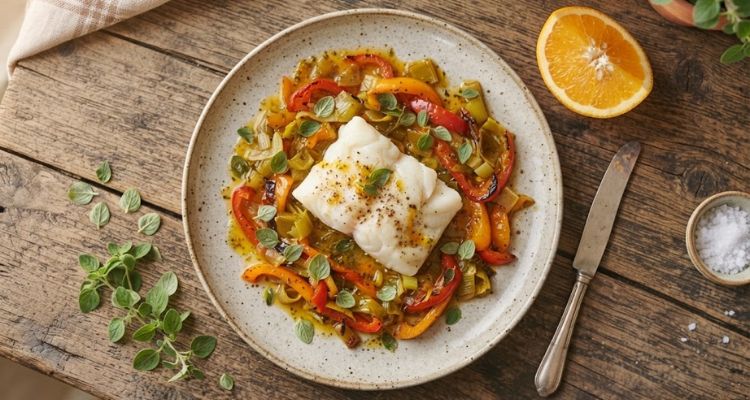
Jamie Oliver’s steamed fish is white fish fillets gently steamed over sweet peppers and leeks, finished with a herby orange dressing. It’s a light, five-ingredient Greek-inspired dish that serves 4 in 32 minutes.
In 5 Ingredients Mediterranean (2023) the trick that sets it apart is salting the fish first. You dust the fillets generously with salt and leave them, which firms up the flesh and makes it flakier, then you rinse it all off before cooking, so it isn’t salty.
The fish then steams straight in the pan, nestled into the softened veg with orange juice and a splash of water under a lid. No steamer basket needed. It cooks in the veg juices, staying delicate, while the raw oregano and orange dressing lifts it at the end.

Jamie Oliver Steamed Fish
Course: Dinner, LunchCuisine: BritishDifficulty: Easy4
servings10
minutes22
minutes276
kcal32
minutesJamie’s light five-ingredient dinner from 5 Ingredients Mediterranean: white fish steamed over sweet peppers and leeks in orange juice, finished with a pounded oregano and orange dressing. Serves four.
Ingredients
4 x 150g white fish fillets, skin off, pin-boned, from sustainable sources
3 mixed-colour peppers
1 large leek
½ a bunch of oregano (10g)
1 large juicy orange
Directions
- Salt the fish:Very generously dust the fish with sea salt to amplify the flakiness, and set aside (you’ll rinse it off later). Put a large shallow casserole pan on medium heat. Chop the peppers into 2cm chunks, discarding seeds and stalks, and add them to the pan with 2 tablespoons of olive oil.
- Soften the veg:Quarter the leek lengthways, wash, and slice 2cm thick. Add to the pan, season, and cook for 15 minutes until sweet and lightly golden, stirring and adding splashes of water if needed.
- Make the dressing:Pound the oregano leaves with a pinch of salt in a pestle and mortar into a paste. Squeeze in half the orange juice, then add 1 tablespoon of red wine vinegar and 2 tablespoons of extra virgin olive oil, and muddle together.
- Steam the fish:Rinse the fish and pat dry. Nestle it into the veg, squeeze in the rest of the orange juice, add 100ml of water, then cover, reduce to low and cook for 7 minutes, until just cooked.
- Serve:Drizzle the orange dressing over the fish and veg, and serve.
FAQs
Why salt the fish and then rinse it off?
It’s a quick dry-brine. Generously salting the fillets and leaving them draws out a little moisture and firms up the flesh, so it holds together and flakes more cleanly once cooked, rather than turning soft and mushy. It’s a small step with a real payoff in texture.
You then rinse it all away and pat the fish dry before cooking, so none of that heavy salt ends up in the dish. Don’t skip the rinsing, or it’ll be too salty, since the seasoning comes from the veg and dressing instead. Ten minutes of salting is plenty.
How does it steam without a steamer?
The pan does the work. Once the peppers and leeks are soft, you nestle the fish down into them, add the orange juice and a splash of water, and clamp on a lid. On a low heat, that liquid turns to steam and gently cooks the fish from below and around, all in one pan.
Keep the heat genuinely low so it steams rather than fries, and resist lifting the lid too often, since each peek lets the steam escape. Seven minutes is usually enough for 150g fillets. The fish is done the moment it turns opaque and flakes at a gentle push.
What white fish works best?
Any firm, sustainable white fish suits this: cod, haddock, pollock, hake or sea bass all work. Choose skinless, pin-boned fillets of even thickness so they cook at the same rate. Thicker fillets may need a minute or two more, thinner ones less.
Buy the freshest you can, since a clean, delicate dish like this has nowhere to hide a tired piece of fish. Frozen fillets work if thawed and patted dry first. This is a gentle way to cook fish that would toughen if fried hard, so it’s forgiving as long as you don’t overcook it.
Why make the dressing in a pestle and mortar?
Pounding the oregano with salt bruises the leaves and releases their oils far more than chopping does, so the dressing tastes greener and more intensely herby. The salt acts as an abrasive that helps break the leaves down into a rough paste.
You then loosen that paste with the orange juice, red wine vinegar and extra virgin olive oil into a punchy, uncooked dressing. Spooned over at the end, its fresh acidity cuts through the sweet veg and delicate fish. If you have no mortar, finely chop the oregano and whisk everything together.
Can I make it for two, or serve it another way?
Yes, Jamie points out it halves easily for two, just use two fillets and roughly halve the veg, keeping the method the same. The timings stay much the same, since the fish still cooks in about 7 minutes once nestled in.
It’s a complete light meal as it is, but a hunk of bread to mop the orangey juices, some new potatoes or a little rice make it more substantial. The bright, Greek-leaning flavours suit a warm evening. There’s more on the Jamie Oliver recipes page.
What can I use instead of oregano or orange?
Fresh thyme or flat-leaf parsley stand in well for the oregano, each giving a slightly different herby note, so use whatever you have. Marjoram, oregano’s milder cousin, is an especially close match if you can find it.
For the orange, a large juicy one gives sweetness that balances the vinegar, but a mix of lemon and a pinch of sugar works if you’re out. Clementines or blood oranges are lovely variations in season. Keep the balance of sweet juice, sharp vinegar and grassy oil, and the dressing will sing.