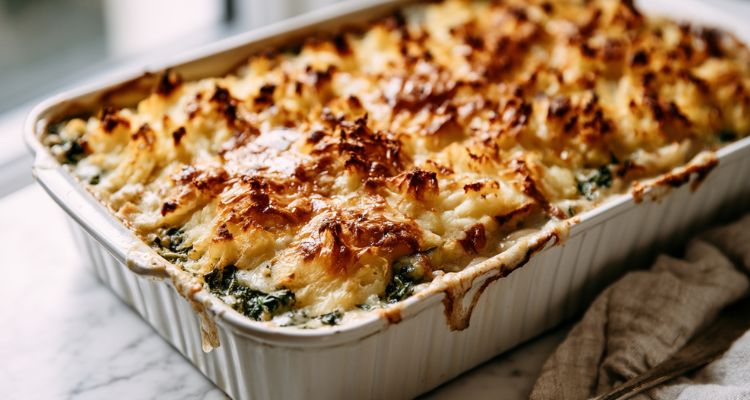
Mary Berry’s Fish Pie with Crushed Potato Topping is made with 400g each of hake and salmon in a dill and lemon white sauce with leek, finished with roughly crushed new potatoes drizzled in olive oil. It bakes at 200°C/fan 180°C/Gas 6 for 30–40 minutes and serves 6. The total time is about an hour.
This recipe comes from Mary Berry Cooks the Perfect: Step by Step (2014), where Berry walks through the technique in full photographic detail. She chose hake deliberately: “Although it has a soft and flaky texture, if handled lightly it’s still dense enough to work well and not break up in a fish pie.” The dill and lemon rind in the sauce are what push this version forward of a standard béchamel.
The whole point of this recipe is the topping. Berry crushes the cooked new potatoes with a fork into rough, uneven pieces, drizzles them with olive oil, and bakes them until the jagged edges catch and turn crisp. She writes: “By crushing them the oil will be absorbed into the potato pieces, which will improve their flavour and make them golden when baked.” You’re aiming for crunchy edges, not smooth mash.

Mary Berry Fish Pie with Crushed Potato Topping
Course: Main, DinnerCuisine: BritishDifficulty: Easy6
servings20
minutes40
minutes560
kcalBerry’s step-by-step version replaces the classic mashed potato lid with olive-oil-drizzled crushed new potatoes that turn crisp in the oven. The filling uses hake alongside salmon, which holds its texture better than cod in a sauce. One baking dish, six servings.
Ingredients
- For the filling:
75g (2½oz) butter, plus extra for greasing
1 large leek, trimmed and cut into 5mm (¼in) thick slices
50g (1¾oz) plain flour
600ml (1 pint) hot, full-fat milk
1½ tbsp chopped fresh dill
finely grated rind of ½ lemon
salt and freshly ground black pepper
400g (14oz) hake fillet, skinned and cut into 2.5cm (1in) cubes
400g (14oz) salmon fillet, skinned and cut into 2.5cm (1in) cubes
200g (7oz) fresh spinach
- For the topping:
800g (1¾lb) new potatoes, such as Charlotte, scrubbed
2 tbsp olive oil, plus 2 tsp for drizzling
Directions
- Make the filling: Grease the baking dish with butter. Melt 50g (1¾oz) of the butter in a large pan over a medium heat. Add the leek and fry for 3 minutes or until softened but not browned. Stir in the flour and cook, stirring, for 1–2 minutes. Remove from the heat and gradually pour in the hot milk. Return to a medium heat and stir until boiling, thickened, and smooth. Stir in the dill, lemon rind, and some salt and pepper. Add the hake and salmon to the sauce. Cook over a low heat for 2 minutes, stirring gently twice, just to start cooking the fish.
- Cool the filling: Pour the fish mixture into the buttered baking dish and set aside to cool completely. You can prepare up to this point 1 day ahead and refrigerate overnight.
- Cook the spinach: Melt the remaining 25g (1oz) butter in a large, non-stick, deep-sided frying pan or sauté pan over a medium heat. Add the spinach and cook, stirring, for 1½–2 minutes or until it wilts. Drain thoroughly in a colander, pressing down with the back of a wooden spoon to extract excess moisture. Roughly chop and set aside. Preheat the oven to 200°C/fan 180°C/400°F/Gas 6.
- Make the crushed potato topping: Put the potatoes in a large pan of cold salted water and bring to the boil. Cover and simmer for about 15 minutes or until tender. Drain well. Return the potatoes to the pan and, using a fork, break them down into rough, chunky pieces. Stir in the 2 tbsp of olive oil and some salt and pepper.
- Assemble and bake: Scatter the spinach on top of the cooled fish mixture, then spoon the potatoes over the spinach layer. Drizzle over the remaining 2 teaspoons of oil and bake for 30–40 minutes or until the pie is bubbling at the edges and the topping is golden and crispy.
FAQs
Why crush the potatoes rather than mash them?
Crushed new potatoes have broken, uneven surfaces that absorb the olive oil differently to smooth mash. The rough edges catch in the oven and become genuinely crisp, while the centres stay slightly waxy and dense from the potato variety. Smooth mash would bake to a soft, floury lid with no texture contrast against the creamy filling below.
Berry uses Charlotte potatoes or similar waxy varieties specifically because they crush without turning to paste. A floury potato like Maris Piper would collapse during crushing rather than breaking into distinct pieces.
How do I stop the filling going watery in the oven?
Three things cause a watery fish pie filling and Berry addresses all three in her step-by-step notes. First, the spinach must be drained so thoroughly that you press the back of a wooden spoon against it in the colander. Second, the filling must be completely cool before you add the spinach layer, or the residual heat will draw moisture out of the spinach. Third, Berry uses hot milk to make the sauce, which produces a thicker, more stable roux from the start.
Cook on a medium heat rather than high when building the sauce, and don’t rush past the “boiling, thickened, and smooth” stage before adding the fish.
What makes hake a better choice here than cod?
Berry explains it directly in her buying note: “Although it has a soft and flaky texture, if handled lightly it’s still dense enough to work well and not break up in a fish pie.” Cod can turn almost mushy in a hot sauce if stirred more than once or twice. Hake has more structural integrity during the 2-minute cooking step, so the pieces stay intact when the filling is transferred to the dish.
If you genuinely can’t find hake, pollock is the closest match in texture. Cod works but requires very gentle handling and absolutely no extra stirring.
Can I leave out the spinach?
The spinach layer between the filling and the topping does two jobs: it adds a faint vegetal contrast to the rich sauce, and it forms a physical barrier that keeps the crushed potatoes from sinking into the filling during baking. Without it, the potato pieces break the surface tension of the cooled sauce and the topping becomes uneven.
If spinach isn’t to your taste, blanched peas work well in the same role. Drain them as carefully as you would the spinach. Berry herself suggests peas as a variation in her Three Fish Pie with Leeks and White Wine, which also uses a similar white sauce base.
How much fish should I use per type?
The recipe calls for 400g of hake and 400g of salmon, with no smoked fish at all. That’s a deliberate choice: the dill and lemon rind in the sauce provide the aromatic contrast that smoked haddock provides in other Berry fish pies. Adding smoked haddock here would compete with the dill rather than complement it.
I tested a version with 300g each of hake, salmon and smoked haddock and found the filling muddied. The simplicity of two fish in this particular sauce is exactly right.
Can I make this without dill?
Dill is the defining flavour of this recipe and skipping it changes the character significantly. If you genuinely dislike dill, tarragon is the next closest match: it has a similar anise edge that works with the lemon rind without overpowering the fish. Use roughly the same quantity, 1½ tablespoons chopped fresh. Flat-leaf parsley would give a cleaner, greener flavour but the sauce would taste more like Berry’s Christmas version than this one. For a comparison of how Berry uses herbs differently across her Mary Berry fish pie collection, each version has a distinct aromatic identity.