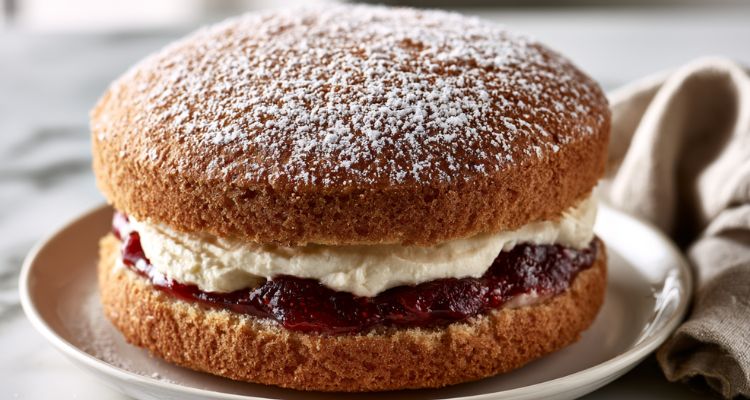
Mary Berry’s Victoria sandwich with cream from her Classic (2018) is a cream-filled version of the British classic, made with cold baking spread, caster sugar, self-raising flour, and eggs, baked at 180°C/160°C fan for 25 minutes, then filled with whipped cream and jam.
In Classic (2018), Berry describes this as “a great British classic” and explains her personal preference directly: “The classic version has just jam, but I like to add whipped cream too to make it extra special.” The whipped cream is the key difference from her earlier versions. It transforms a teatime staple into something closer to a celebration cake, which is exactly how she served it: “I made it as part of a tennis tea and it was welcomed with lots of complimentary oohs and ahhs!”
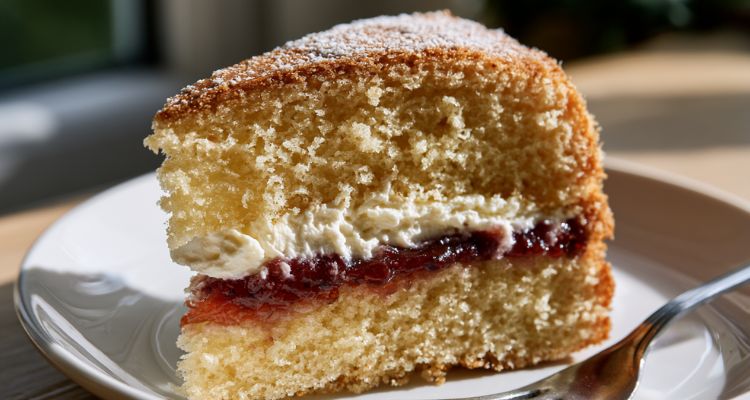
The technique that makes this version work is the assembly order. Berry places the sponge with the better-looking top face-up on the finished cake, which means flipping the first layer top-side down before spreading. Spreading jam onto a flat base, then cream on top, gives a stable, even layer that doesn’t slide when the second sponge is placed on top.
Mary Berry Victoria Sandwich With Cream Recipe
Course: DessertCuisine: BritishDifficulty: Easy6-8
servings15
minutes25
minutes545
kcalFrom Classic (2018), Berry’s most recent take on her Victoria sandwich adds whipped double cream to the filling alongside strawberry or raspberry jam. The sponge itself uses cold baking spread rather than softened butter, which means no waiting for butter to come to room temperature.
Ingredients
- For the sponge:
225g (8oz) cold baking spread, plus extra for greasing
225g (8oz) caster sugar, plus extra for sprinkling
225g (8oz) self-raising flour
2 level teaspoons baking powder
4 eggs
- For the filling:
150ml (5fl oz) double cream
About 4 tablespoons strawberry or raspberry jam
Directions
- Preheat: You will need two 20cm (8in) round, loose-bottomed sandwich tins with deep sides. Preheat the oven to 180°C/160°C fan/Gas 4, then lightly grease the tins and line each base with a disc of baking paper.
- Mix: Measure the baking spread, sugar, flour, and baking powder into a large bowl, add the eggs and, using either a wooden spoon or an electric hand whisk, beat for about 2 minutes until just blended. Divide the mixture evenly between the prepared tins and level the tops.
- Bake: Bake in the oven for about 25 minutes, or until well risen and golden. The tops of the sponges should spring back when pressed lightly with a finger. Leave to cool in the tins for around 10 minutes until cool to the touch, then run a blunt knife around the edge of the tins to free the sides of the sponges. Turn the cakes out, peel off the baking paper, and leave to cool completely on a wire rack.
- Assemble: Whip the cream into soft peaks, then choose the cake with the best top and place the other sponge top-side down on a serving plate. Spread with the jam and the whipped cream. Sit the other cake on top (top side up) and sprinkle with caster sugar to serve.
Notes
- Calculation: 225g baking spread (1,575 kcal) + 225g caster sugar (871 kcal) + 4 eggs (312 kcal) + 225g self-raising flour (776 kcal) + 150ml double cream (674 kcal) + 60g jam (150 kcal) = 4,358 kcal ÷ 8 = 545 kcal. Caster sugar topping excluded as negligible. Calculated using 8 servings from the stated range of 6–8.
FAQs
Why does this recipe use cold baking spread instead of softened butter?
Cold baking spread is one of the biggest practical differences between Berry’s 2018 version and her earlier ones. Baking spreads have a higher water content and a softer fat structure than butter, so they blend immediately even straight from the fridge, which means there’s no waiting for butter to soften. The trade-off, as Berry notes in her Baking Bible, is keeping time: a sponge made with baking spread “won’t keep as long” as one made with butter, so this version is best eaten on the day or assembled just before serving.
Can I make this Victoria sandwich ahead of time?
Berry’s own note in Classic (2018) says yes: the assembled cake can be made up to 8 hours ahead. The cream holds better than most people expect because it’s whipped to soft peaks rather than stiff, which gives it just enough structure to sit without weeping. For anything beyond 8 hours, keep the sponges unfilled and wrapped, then whip the cream and assemble on the day. If you’re serving at a summer party, keep the assembled cake in the fridge and bring it out 20 minutes before serving, so the sponge isn’t cold when you cut it.
How do I add cream to a Victoria sponge without it going soggy?
Two things prevent a soggy sponge: cool layers and whipped rather than poured cream. Both sponges must be completely cold before you spread anything, because warm sponge melts cream on contact and the moisture soaks straight in. Berry spreads the jam first, directly onto the flat base of the bottom layer, then spoons the cream on top of the jam. The jam acts as a light barrier between the sponge and the cream, slowing absorption. Soft peaks are firm enough to hold their shape but won’t press the sponge down the way stiffly whipped cream can.
How do I avoid marks on the top of my Victoria sponge?
Berry’s tip in Classic is specific: place each sponge bottom side down on the wire rack while it cools, rather than right side up. The wire rack leaves a grid of indentations on whichever surface rests on it. Since you’ll be turning the finished cake out top-side up, any marks on the underside will be hidden inside the cake once it’s assembled. The flat base of the tin also means the bottom of each sponge is the smoothest surface, so it doubles as the presentation top if needed.
How long does a Victoria sponge with cream keep?
A cream-filled Victoria sponge keeps well for up to 8 hours at room temperature, which aligns exactly with Berry’s prepare-ahead guidance in Classic (2018). Beyond that, refrigerate it, but expect the sponge to firm slightly in the cold. The sponges themselves, unfilled and wrapped in cling film, will keep for one to two days or can be frozen for up to three months. Once the cream is inside, the clock is running, so don’t assemble this the night before a party unless you have refrigerator space and are happy to serve it cold.