Mary Berry’s Victoria sponge from her Baking Bible is a classic all-in-one cake made with softened butter, caster sugar, self-raising flour, and four large eggs, baked at 180°C/Fan 160°C for 25 minutes and finished with jam and a dusting of caster sugar.
In Mary Berry’s Baking Bible (2010), she calls it “the best known and loved of all family cakes” and uses the all-in-one method throughout, noting that it “takes away the hassle of creaming, and ensures success every time.” What makes her Baking Bible version distinct is the choice of fat: softened butter, not baking spread. She acknowledges that spreads work, but adds plainly that the cake won’t keep as long if you use one.
The technique that most home bakers get wrong here is the mixing time. Berry beats everything together until thoroughly blended, but the Baking Bible warns against going further than that. Over-beating incorporates too much air, which collapses in the oven and produces a dense, sunken sponge rather than a light, even rise.
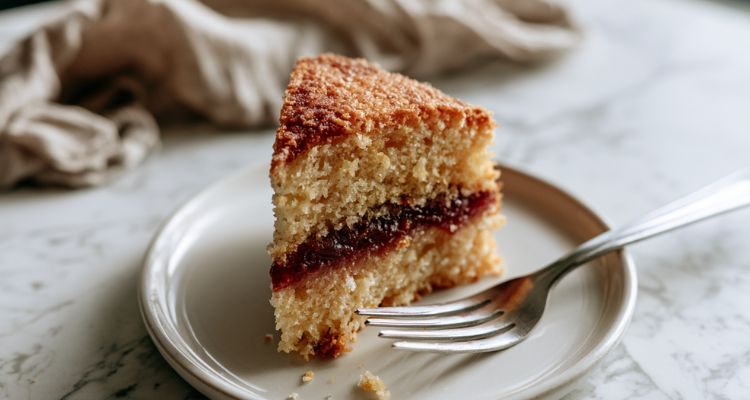
Mary Berry Victoria Sponge Recipe
Course: DessertCuisine: BritishDifficulty: Easy8
servings15
minutes25
minutes465
kcalBerry’s flagship recipe from Mary Berry’s Baking Bible (2010), this is the version she has taught for decades: four ingredients in equal weights, all beaten together, jam sandwiched between the layers. It serves 8 and uses no cream, no buttercream, just good-quality jam and a sprinkle of sugar.
Ingredients
- For the sponge:
225g (8oz) softened butter, plus extra for greasing
225g (8oz) caster sugar
4 large eggs
225g (8oz) self-raising flour
2 level teaspoons baking powder
- For the filling and topping:
4 tablespoons strawberry or raspberry jam
A little caster sugar, for sprinkling
Directions
- Preheat: Set the oven to 180°C/Fan 160°C/Gas 4. Grease two 20cm (8in) sandwich tins, then line the base of each with baking parchment.
- Mix: Measure the butter, sugar, eggs, flour, and baking powder into a large bowl and beat until thoroughly blended. Divide the mixture evenly between the tins and level out.
- Bake: Bake for about 25 minutes, or until well risen and the tops spring back when lightly pressed with a finger. Leave to cool in the tins for a few minutes, then turn out, peel off the parchment, and finish cooling on a wire rack.
- Assemble: When completely cold, sandwich the cakes together with the jam. Sprinkle with caster sugar to serve.
Notes
- Calculation: 225g butter (1,613 kcal) + 225g caster sugar (871 kcal) + 4 eggs (312 kcal) + 225g self-raising flour (776 kcal) + 60g jam (150 kcal) = 3,722 kcal ÷ 8 = 465 kcal. Caster sugar topping excluded as negligible.
FAQs
Why did my Mary Berry Victoria sponge sink in the middle?
The most common cause is opening the oven door before the sponge has set, which lets cold air collapse the half-risen structure. Berry is explicit in her Cookery Course (2015): “Do not be tempted to open the oven door before 20 minutes, or the cakes will sink.” A second cause is under-baking: the spring-back test only works if you press very lightly with one fingertip, not push down firmly, and only in the very centre of the cake. If your oven runs cool, add three to four minutes and trust the spring-back test over the timer.
What jam does Mary Berry use in her Victoria sponge?
Berry specifies strawberry or raspberry jam in every version of this recipe across her books, and in her Cookery Course she adds: “I always use a really good-quality jam.” Raspberry has a slight edge in acidity, which cuts through the richness of the butter sponge more cleanly than strawberry. If you use a loose, syrupy jam, warm it gently and stir until it firms slightly before spreading, so it doesn’t soak into the sponge.
Should I use butter or baking spread for this recipe?
For the Baking Bible version specifically, Berry calls for softened butter, and she notes in her headnote that while baking spreads give a good result, “the cake won’t keep as long.” The difference is water content: baking spreads contain more water than butter, which affects how the crumb sets overnight. If you plan to eat the cake on the day it’s made, either works; if you’re baking ahead or want it to last two days, butter is the right choice here.
How do I get both sponge layers to rise evenly?
Dividing the mixture by weight, not eye, is the single most reliable fix. Put each tin on a digital scale and spoon in until both read the same, then level the tops with a palette knife so the surface is flat rather than mounded. Berry also notes in her Ultimate Cake Book that the tins must be greased evenly, because any dry patch will cause the sponge to pull away unevenly as it rises. Two identical tins of the same depth matter too: thin sandwich tins bake faster and brown before the centre sets.
Can you freeze a Mary Berry Victoria sponge?
Yes, but freeze the sponge layers separately before adding the jam filling. Wrap each cold sponge tightly in cling film, then in foil, and freeze for up to three months. Defrost at room temperature for two to three hours, then assemble with fresh jam once fully thawed. The Baking Bible chapter intro notes that “wedges of sponge and fruit cake freeze well,” and the general principle holds: it’s the jam that doesn’t freeze well, not the sponge itself. A sponge assembled before freezing will have a wet, compressed layer where the jam was once it thaws.