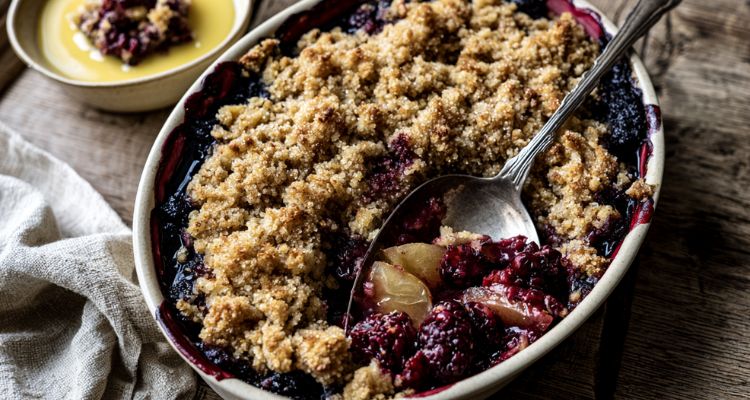
Mary Berry’s apple and blackberry crumble is made with thickly sliced Bramley apples and fresh blackberries under a semolina-spiked crumble topping, baked at 200°C (180°C fan) for 45 to 50 minutes. It serves 6 and Berry says to serve it with custard, cream or ice cream.
Berry published this in Simple Comforts (2020) and her headnote captures what she’s after: “Expect the fruit juices to ooze around the edges and seep a little into the topping — this is all part of a crumble’s charm.” She’s not trying to keep the topping dry and separate from the fruit, which is the opposite of what most recipes aim for.
The semolina in the crumble is the detail worth paying attention to. Berry explains in her Cookery Course (2015) that “using half semolina to flour is a simple way to add texture and crunch to the baked crumble topping.” It absorbs the fruit juices rising from below without turning the topping soggy, which plain flour alone can’t do as well.
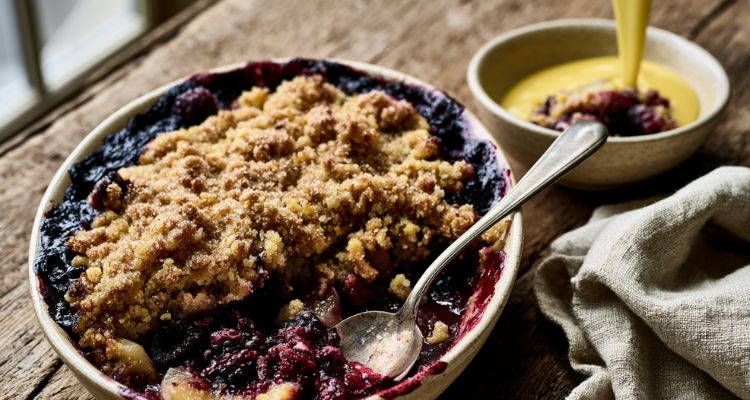
Mary Berry Blackberry and Apple Crumble Recipe
Course: SnacksCuisine: BritishDifficulty: Easy10
servings15
minutes45
minutes450
kcal55
minutesBerry uses two sugars in the topping — muscovado rubbed into the crumble for a toffee depth, then demerara sprinkled on top for crunch. It’s the kind of double layer you’d only think of after making crumbles for sixty years.
Ingredients
- For the filling:
700g (1 lb 7 oz) Bramley apples, peeled and thickly sliced
600g (1 lb 5 oz) fresh blackberries
75g (3 oz) caster sugar
- For the crumble topping:
175g (6 oz) plain flour
50g (2 oz) semolina
50g (2 oz) light brown muscovado sugar
100g (4 oz) butter, cubed
25g (1 oz) demerara sugar, for sprinkling
Directions
- Preheat: Set the oven to 200°C/180°C fan/Gas 6 (400°F). You will need a shallow 1.75-litre (3-pint) ovenproof dish.
- Prepare the fruit: Measure the apples, blackberries and sugar into the dish. Using a spoon, toss to coat the fruit in the sugar.
- Make the crumble: Measure the topping ingredients, except the demerara sugar, into a food processor. Whizz for a few moments until the mixture resembles breadcrumbs. Alternatively, rub the flour, semolina and muscovado sugar into the butter with your fingertips.
- Assemble and bake: Scatter the crumble mixture evenly over the fruits and sprinkle the demerara sugar on top. Bake for about 45–50 minutes until pale golden brown on top and bubbling around the edges. Serve with custard, cream or ice cream.
Notes
- Calories: 700g apples (329) + 600g blackberries (258) + 75g caster sugar (290) + 175g plain flour (637) + 50g semolina (180) + 50g muscovado (190) + 100g butter (717) + 25g demerara (97) = 2,698 ÷ 6 = 450 kcal per serving
FAQs
Why does Mary Berry add semolina to the crumble topping?
Berry teaches this technique in her Cookery Course (2015), where she explains that semolina “adds texture and crunch to the baked crumble topping.” It’s coarser than flour and doesn’t absorb fat the same way, so the finished topping stays gritty and crisp instead of turning soft and cakey. Her Plum and Apple Crumble in the same book uses the same flour-semolina split.
The semolina also acts as a barrier between the bubbling fruit and the crumble. It soaks up juice without going soggy, which is why Berry’s topping stays crunchy even though she expects the fruit to “ooze around the edges.” If you can’t find semolina, Berry’s Everyday tip from her Blackberry and Apple Crumble Pie (2017) says ground rice works as a straight swap.
Can I use frozen blackberries instead of fresh?
Berry specifies fresh blackberries and calls this “perfect for an autumn day when apples and blackberries are in season,” but frozen ones work if you handle them right. Don’t thaw them first or they’ll release too much water before the crumble even goes in the oven. Scatter them frozen directly onto the apples and add 5 extra minutes to the bake time.
I’ve made this with frozen blackberries in February and the only noticeable difference was a slightly wetter base, which the semolina in the topping handled well. The colour bleeds more from frozen fruit too, so the apple slices turn a deeper purple than they would with fresh. It still tastes like autumn even if it’s the middle of winter.
Why does Berry use two types of sugar in the crumble topping?
The muscovado gets rubbed into the flour and butter, where it adds a toffee-like depth to the crumble itself. Berry writes in her Cookery Course that “light muscovado is delicious in cakes and biscuits, and gives a good colour as well as flavour.” The demerara goes on top, where its large crystals stay intact during baking and give the surface a proper crunch.
If you used caster sugar for both jobs you’d lose that contrast. Berry also warns to “always add the sugar after working in the butter” because “if you add the sugar beforehand, the mixture will become too sticky to handle.” That’s why the muscovado goes in after the rubbing-in stage, not before.
How far ahead can I make this crumble?
Berry gives two specific storage notes. It can be assembled up to 6 hours ahead and kept at room temperature before baking, and it freezes well assembled but unbaked. That means you can build it in the morning and bake it after lunch, or freeze it for weeks and bake it straight from the freezer with an extra 10 to 15 minutes added.
I assemble and freeze them in foil trays so I don’t tie up my good ovenproof dish. Wrap the whole thing tightly in cling film, then foil on top, and it keeps for a good two months. Bake from frozen at the same temperature and check it’s bubbling right through before you take it out.
What’s the difference between this and Berry’s blackberry and apple crumble pie?
Berry’s Blackberry and Apple Crumble Pie from Everyday (2017) is a completely different recipe. It has a shortcrust pastry base with a crumble top, and the filling is pre-cooked on the hob then thickened with cornflour before going into a traybake tin. The crumble topping is made into a dough, chilled, then grated over the fruit, which gives a different texture entirely.
This Simple Comforts version is a proper crumble with no pastry at all. Raw fruit goes straight into the dish, the crumble is scattered on top, and the whole thing bakes together. It’s simpler, quicker and more rustic. The pie version is designed to be cut into neat squares, while this one is scooped out of the dish with a big spoon.
Why does Berry thickly slice the apples instead of chopping them?
Thick slices hold their shape better during the 45 to 50 minute bake. Berry writes in her Cookery Course that “Bramleys are the most famous of English cooking apples” and that “they soften down beautifully during baking.” Thick slices give you pieces that are soft and yielding but still recognisable as apple, rather than a collapsed purée at the bottom of the dish.
If you chop them small or slice them thin, Bramleys will break down completely in under 30 minutes and you’ll end up with apple sauce under the crumble. That’s not necessarily bad, but it’s not what Berry’s going for here. She wants you to get a chunk of soft apple, a burst of blackberry and a crunch of crumble in the same spoonful.