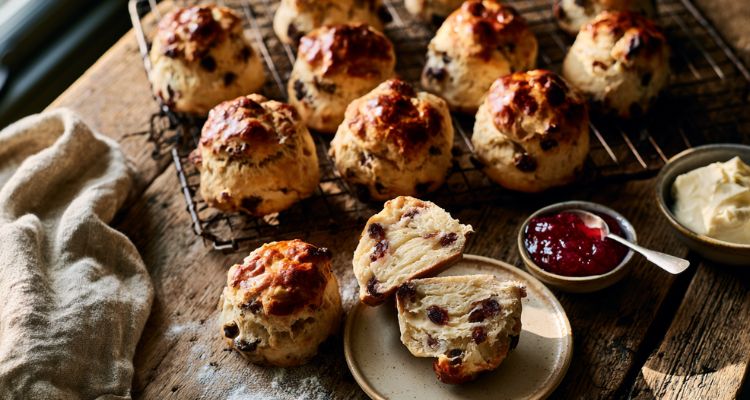
Mary Berry’s fruity scones are buttery sultana scones made with chilled butter, self-raising flour, eggs and milk, baked at 220°C (200°C fan/Gas 7) for about 10 minutes. The recipe makes 10 using a 6cm plain cutter, rolled to a full 2cm thick.
Berry published this in her Cookery Course (2015) as a step-by-step teaching recipe, complete with technique photographs. Her headnote says it all: “My favourite way to serve scones is split open, rather than sandwiched together. That way, you get lots of jam and cream.”
The detail that separates this from her other scone recipes is the temperature of the butter. Berry specifies chilled butter cut into cubes and a chilled mixing bowl, then says to rub in “lightly and quickly.” That cold start is what gives these a shorter, flakier crumb than the softer scones she makes elsewhere.
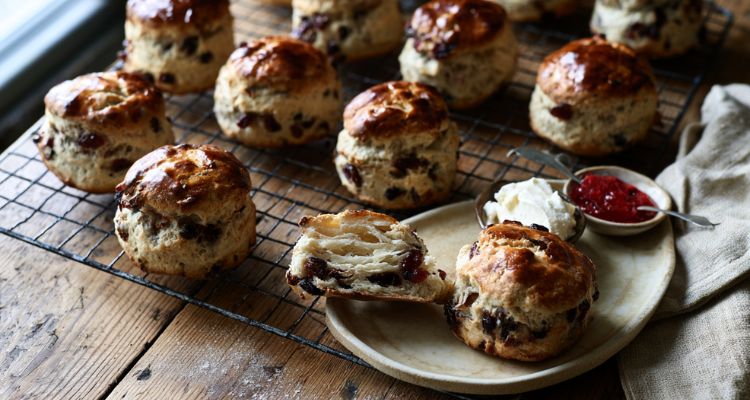
Mary Berry Fruity Scones
Course: SnacksCuisine: BritishDifficulty: Easy10
servings15
minutes10
minutes238
kcal28
minutesBerry’s teaching recipe from Cookery Course, with a built-in tip section explaining why scones go wrong. She says to “roll them out quite thickly to start with; they never rise as much as you think they will.”
Ingredients
75g (2½ oz) butter, chilled and cut into cubes, plus extra for greasing
350g (12 oz) self-raising flour, plus extra for dusting
1½ tsp baking powder
30g (1 oz) caster sugar
75g (2½ oz) sultanas
About 150ml (5 fl oz) milk
2 large eggs, beaten
Directions
- Preheat: Set the oven to 220°C/200°C fan/Gas 7 (425°F). Lightly grease a large baking sheet.
- Rub in: Put the flour and baking powder into a large chilled mixing bowl. Add the cubes of butter, keeping all the ingredients as cold as possible. Rub in lightly and quickly with your fingertips until the mixture looks like fine breadcrumbs. Stir in the sugar and sultanas.
- Mix the dough: Pour 100ml of the milk and all but 2 tablespoons of the beaten egg into the flour mixture. Mix together with a round-bladed knife to a soft, but not too sticky dough, adding a bit more milk if needed to mop up any dry bits of mixture in the bottom of the bowl.
- Shape: Turn the dough out onto a lightly floured work surface, lightly knead just a few times only until gathered together, then gently roll and pat out to form a rectangle about 2cm (¾ in) deep. Cut out as many rounds as possible from the first rolling with a 6cm (2½ in) cutter and lay them on the baking sheet, spaced slightly apart. Gather the trimmings, then roll and cut out again. Repeat until you have 10 scones.
- Bake: Brush the tops of the scones with the reserved egg. Bake for about 10 minutes, or until risen and golden. Remove and cool on a wire rack.
Notes
- My verification: 75g butter (538) + 350g SR flour (1,208) + 30g sugar (116) + 75g sultanas (224) + 150ml milk (92) + 2 eggs (156) = 2,334 ÷ 10 = 233 kcal. Berry’s published figure of 238 is close; difference likely from rounding or a slightly different butter weight. Using Berry’s figure.
FAQs
Why does Berry use chilled butter here when other scone recipes call for softened?
Her Very Best Scones in Baking Bible (2010) use softened butter, and the Buttermilk and Sultana Scones from Mary Berry at Home call for cubed butter without specifying temperature. This Cookery Course recipe is the only scone where she explicitly says chilled, and she goes further by telling you to chill the mixing bowl too.
Cold butter doesn’t blend as smoothly into the flour, which is the point. You end up with small flakes of butter distributed through the dough rather than a uniform mixture. Those flakes melt in the oven and create tiny steam pockets, giving the finished scone a lighter, shorter texture. It’s the same principle Berry applies to her pastry, where she warns to “keep things cool” and to “ensure your butter is chilled before using.”
Why does Berry recommend a plain cutter instead of fluted here?
She writes that “a plain cutter is easier to use than a fluted one,” which contradicts her usual rule. In the Ultimate Cake Book (2003) she says fluted cutters are for sweet scones and plain cutters are for savoury. In Mary Berry Cooks (2014) she uses a fluted cutter for her Teatime Scones.
The practical reason is the dough. These scones are rolled thicker at 2cm, and a fluted cutter can drag through a deeper dough and compress the edges, which stops them rising cleanly. A plain cutter gives a cleaner cut through thicker dough. Berry also says to dip the cutter in flour before each cut to stop the dough sticking, which is easier to do with a smooth edge.
Can I make these as plain scones without the sultanas?
Berry answers this herself in the headnote: “For plain scones, simply omit the sultanas.” Nothing else changes. The quantities, method and bake time all stay the same, giving you 10 plain scones with the same chilled butter crumb.
I’ve made both versions and the plain ones are excellent with jam and cream on their own. Without the sultanas the scone is slightly lighter because there’s no fruit weighing the dough down, so they puff up a fraction more in the oven. If you want a plainer scone that’s still got something going on, a teaspoon of lemon zest stirred into the dry ingredients works well, which is one of Berry’s own variations from Mary Berry Cooks (2014).
How do these compare to Berry’s Special Fruit Scones from Baking Bible?
The Special Fruit Scones from Baking Bible (2010) are a smaller, simpler recipe: 225g flour, 50g softened butter, 25g sugar, 50g mixed dried fruit, one egg, and a 5cm fluted cutter rolled to 1cm thick. They make about 14 thinner scones and use softened butter rather than chilled.
These Fruity Scones are richer and taller in every way. More flour (350g), more butter (75g), more fruit (75g), two eggs instead of one, and double the thickness at 2cm. The chilled butter also gives a different texture. If the Special Fruit Scones are a quick everyday batch, these are the ones you’d make for a proper afternoon tea where the scones need to hold their own next to the jam and cream.
How do I store fruity scones?
Berry’s headnote says to “make them ahead and reheat in a low oven,” and her general scone advice from Entertaining (2020) is to “bake scones on the day” but if you must prepare ahead, “freeze them and then gently reheat in a low oven once defrosted.” She also says there’s “no need for butter” when serving with jam and cream, since the scone is already rich enough.
I freeze them on a flat tray first, then bag them once they’re solid so they don’t stick together. They reheat from frozen in about 8 minutes at 160°C, and they come out close to freshly baked if you eat them within a month. After a month the texture starts to dry out, even wrapped tightly.
Why does Berry say scones never rise as much as you think?
Her tip section for this recipe explains it: “Roll them out quite thickly to start with; they never rise as much as you think they will.” Most home bakers roll scones to about 1cm and expect them to double in the oven, but they don’t. Berry’s 2cm starting thickness here is deliberate because she wants tall, chunky scones that split easily in half.
The other part of her tip is just as useful: “Scones need a light touch or they can become tough and heavy, so handle them as little as possible.” She says to knead “just a few times only until gathered together,” which is barely any kneading at all. Overworking the dough develops the gluten, and gluten makes scones chewy instead of crumbly. Berry wants you in and out of the dough as fast as possible.