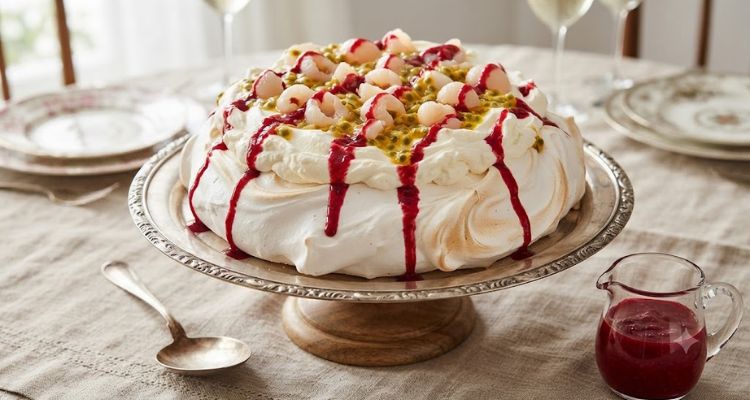
Nigella Lawson’s prodigious pavlova is a giant billowing meringue, crisp outside and marshmallow-soft within, piled with softly whipped cream and a tumble of passionfruit, lychees and raspberry sauce. The tropical fruit cuts through the sweetness. It makes 14 generous slices and needs an hour in the oven plus cooling.
The recipe is from Nigella Christmas, and it’s built to be a centrepiece. She uses eight egg whites and 500g of sugar for real height, with the classic pavlova trio of cornflour, vinegar and vanilla folded in for that soft, chewy middle. The topping is where it turns showy: passionfruit and torn lychees with their juices, and a vivid raspberry sauce zig-zagged over.
The one thing that makes or breaks a pavlova is the oven. Nigella puts it in at 180C, then drops the heat to 120C the moment the door shuts, and leaves it to cool inside completely after baking. That slow cool is what stops the meringue cracking and sinking as it comes down to temperature.
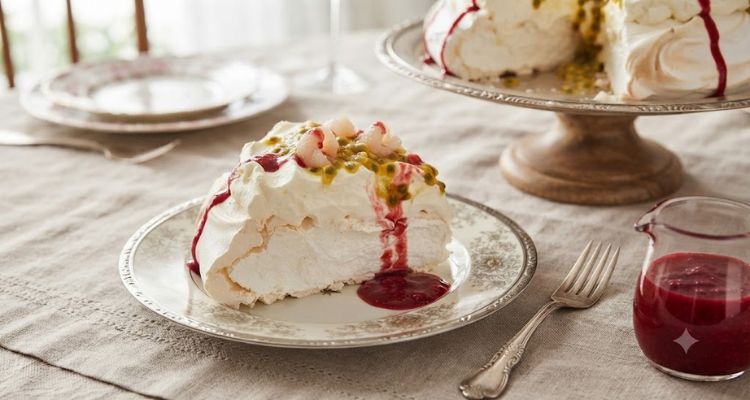
Nigella Lawson Prodigious Pavlova
Course: DessertCuisine: BritishDifficulty: Easy14
servings25
minutes1
hour320
kcal3
hoursFrom Nigella Christmas. A make-ahead showstopper meringue with soft cream and a tropical tangle of passionfruit, lychees and raspberry sauce, built to feed a crowd.
Ingredients
- For the base:
8 egg whites
500g caster sugar
4 tsp cornflour
2 tsp white wine vinegar
½ tsp vanilla extract
- For the topping:
650ml double cream
10 passionfruit
10 fresh or canned lychees, drained if canned
300g raspberries (frozen are fine)
25g icing sugar
Directions
- Preheat and prep: Preheat the oven to 180°C (gas mark 4). Line a baking sheet with baking parchment and draw a rough 25cm circle on it, pencilling round a cake tin.
- Whisk the meringue: Whisk the egg whites until satiny peaks form, then whisk in the sugar a tablespoon at a time until the meringue is stiff and shiny.
- Fold in: Sprinkle over the cornflour, vinegar and vanilla, and fold in lightly with a metal spoon. Mound the meringue within the circle on the parchment, then flatten the top and smooth the sides with a spatula.
- Bake low and slow: Put it in the oven and immediately reduce the heat to 120°C (gas mark ½). Bake for an hour, then turn the oven off and leave the meringue to cool completely inside. Once cool, it keeps in an airtight container for a couple of days, or freezes for a month.
- Assemble: Invert the cooled meringue onto a serving plate and peel off the parchment. Whip the cream until thickened but still soft, and pile it onto the squidgy underside, spreading to the edges in swirls.
- Prepare the fruit: Halve the passionfruit and scoop the seeds, pulp and juice into a bowl. Peel the fresh lychees over the bowl to catch the juice, remove the stones, tear into pieces and add them (or tear in drained canned lychees). Liquidise the raspberries with the icing sugar in a blender.
- Finish: Dollop the passionfruit and lychees with their juices over the cream, then zig-zag over some of the raspberry sauce, serving the rest in a jug alongside.
FAQs
Why put it in a hot oven then turn it down straight away?
The initial blast of heat sets the outside of the meringue quickly, then the low 120C cooks it gently so the middle stays soft and marshmallowy. Leaving it to cool in the switched-off oven is just as important, since a sudden temperature drop is what cracks and collapses a pavlova. Patience here beats any other trick.
What do the cornflour and vinegar do?
This is the classic pavlova combination: the cornflour and vinegar give that signature contrast of crisp shell and soft, chewy centre, rather than a meringue that’s crisp all the way through. Without them you’d have a hard, dry meringue. Fold them in gently with a metal spoon so you don’t knock the air out.
Why use lychees and passionfruit instead of just berries?
The sharp passionfruit and floral lychees cut through the sweet meringue and rich cream far better than berries alone, which is what stops a pavlova being sickly. Their juices soak in slightly for extra flavour, while the raspberry sauce adds colour and tartness. It’s the tang that makes this feel special rather than just sweet.
Can I make the pavlova ahead?
Yes, and Nigella designs it for that. Make the meringue disc up to 2 days ahead in an airtight container, or freeze it for a month. Top it with whipped cream 3 to 4 hours before serving and keep it in the fridge, then add the fruit and raspberry sauce only just before it goes to the table, so nothing goes soggy.
Why spread the cream on the underside of the meringue?
The base that sat against the parchment is the soft, squidgy side, and piling the cream there gives you that lovely contrast against the crisp top edges. It also makes for a more stable platform than the domed top. Invert the disc onto your serving plate first, then build from there.
How do I stop my pavlova weeping or going flat?
Make sure every trace of sugar is dissolved into stiff, glossy meringue before baking, since undissolved sugar is what makes a pavlova weep. Add the sugar slowly, a spoonful at a time, and don’t rush the whisking. Then respect the slow cool in the oven, and assemble as late as possible so the cream and fruit don’t soften the shell.