Delia Smith’s asparagus with nearly hollandaise is steamed English asparagus with a cheat’s sauce made from crème fraîche, egg yolks, vinegar and lemon juice. It serves 4 as a starter, takes about 15 minutes and comes from her How to Cheat at Cooking book.
This comes from How to Cheat at Cooking, but Delia also has a proper foaming hollandaise in her Summer Collection. The cheat swaps the tricky butter emulsion for crème fraîche thickened with cornflour, so it can’t split.
The asparagus method matters as much as the sauce. Delia insists on a fan steamer in a wide lidded pan with 2.5cm of simmering water. She says 4-6 minutes, testing with a knife tip. Boiling asparagus drowns the flavour, which is why she steams.
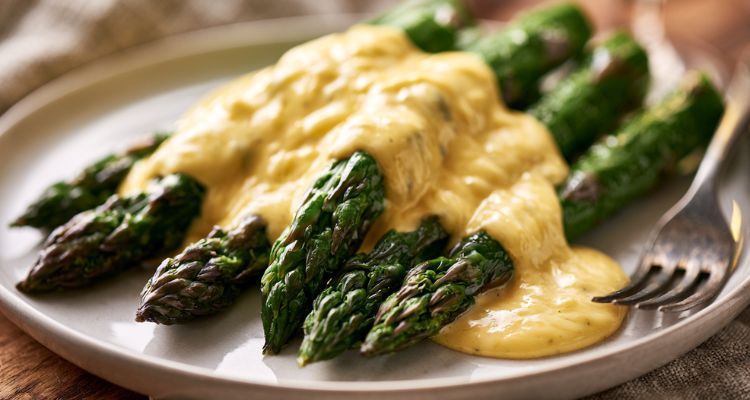
Delia Smith Asparagus with Nearly Hollandaise
Course: SidesCuisine: BritishDifficulty: Easy4
servings5
minutes10
minutes274
kcal15
minutesAdapted from Delia’s How to Cheat at Cooking. A split-proof cheat’s hollandaise using crème fraîche instead of a butter emulsion, paired with steamed English asparagus. Delia notes you can make the sauce ahead and reheat it over a pan of hot water.
Ingredients
- For the asparagus:
2 x 300g asparagus
- For the nearly hollandaise:
1 x 200ml tub crème fraîche
1 teaspoon cornflour
2 large or 3 medium egg yolks
¾ tablespoon white wine vinegar
1 dessertspoon lemon juice
2 tablespoons softened butter
Seasoning
- Equipment
Fan steamer
Wide lidded pan
Directions
- Snap off the woody ends of the asparagus. Bend each stalk and the bit that snaps off is the bit you don’t want.
- Add boiling water from the kettle to the wide pan to a depth of about 2.5cm. Place the stalks on the spread-out fan steamer and sit it in the pan. Add some salt, and simmer with a lid on for 4-6 minutes, or until the stalks are tender when tested with the tip of a knife or a small skewer.
- Meanwhile, spoon the crème fraîche into a small saucepan, then add the cornflour, egg yolks, vinegar and lemon juice. Whisk them all together with a mini whisk.
- Over a medium heat, bring the whole lot up to simmering point, whisking continuously, until the sauce has thickened.
- Remove from the heat, taste and add seasoning, more vinegar or lemon juice if needed, then whisk in the butter.
- Serve the asparagus on hot plates with the sauce poured over. You’ll also need lots of good bread to mop up the juices.
Notes
- You can make the hollandaise sauce in advance and reheat it set over a pan of hot water. For a more substantial supper, add one or two lightly poached eggs per person on top of the asparagus and pour the sauce over.
FAQs
How is this different from a real hollandaise?
Traditional hollandaise is a warm emulsion of egg yolks and 100-175g of melted butter, held together by technique. Too much heat and the eggs scramble. Too much butter too fast and it splits. Delia’s cheat replaces that entire process with crème fraîche. The crème fraîche provides the body, the cornflour prevents splitting, and only two tablespoons of butter go in at the end for richness. It can’t split because there’s no emulsion to break. The trade-off is that it tastes lighter and slightly tangier than the real thing, which Delia considers a plus for asparagus.
Why does Delia steam the asparagus instead of boiling or roasting it?
Boiling waterlogged asparagus is a common British complaint, and Delia’s answer is the fan steamer. The stalks sit above the water, so they cook in steam rather than submerging. This keeps the flavour concentrated and the texture firm with a slight bite.
Roasting works too, but Delia doesn’t suggest it here because roasted asparagus develops caramelised edges that compete with the sauce. Steamed spears are clean and mild, which lets the hollandaise be the star. If you don’t own a fan steamer, use a wide frying pan with 2cm of simmering water and a lid. Same principle, similar result.
Can I make the sauce ahead of time?
Yes, and Delia says so in the recipe notes. Make the sauce, let it cool, then reheat it set over a pan of hot water, whisking gently. The crème fraîche base is much more stable than a real hollandaise, so it reheats without splitting.
This is the real advantage of the cheat version. A traditional hollandaise is best served within minutes. It sits badly, separates when reheated, and can’t be refrigerated and brought back. Delia’s version behaves like a normal sauce. If you’re cooking for a dinner party, make it an hour before guests arrive and reheat while the asparagus steams.
What does the cornflour do in the sauce?
The cornflour acts as insurance. When you heat egg yolks with acid, there’s a risk they’ll curdle into scrambled egg instead of thickening smoothly. Cornflour raises the temperature at which the egg proteins set, giving you a wider safety margin.
One teaspoon is all Delia uses. Enough to stabilise, not enough to make the sauce taste starchy. If you’ve ever made a crème pâtissière, it’s the same principle: cornflour lets you heat egg yolks more aggressively without them splitting. Delia’s vanilla ice cream uses a similar shortcut thinking, replacing the traditional custard base with condensed milk.
Can I use this sauce with other vegetables?
The sauce works with anything you’d pair with regular hollandaise. Poached salmon is the classic British match. Purple sprouting broccoli in February and March is excellent, because the slight bitterness of the broccoli plays well against the tang of the crème fraîche.
Delia herself suggests adding poached eggs on top for a more substantial meal, which turns this starter into eggs Benedict without the muffin. Globe artichokes with the sauce for dipping are another strong option. The sauce keeps well enough that you can make a batch and use it across two meals, reheating over hot water each time.
When is the best time to make this recipe?
English asparagus runs from late April to late June, with peak season in May. Delia says “hurry, hurry” because the window is short. Out-of-season asparagus imported from Peru or Mexico is thinner, tougher and tastes of very little compared to fresh English spears.
Look for thick stalks with tight, compact tips. If the tips are opening or flowering, the asparagus is past its best. British supermarkets label origin during season. Farm shops near the Vale of Evesham or East Anglia sell it cut that morning. That same-day freshness is what Delia means when she calls English asparagus “best in the world.”