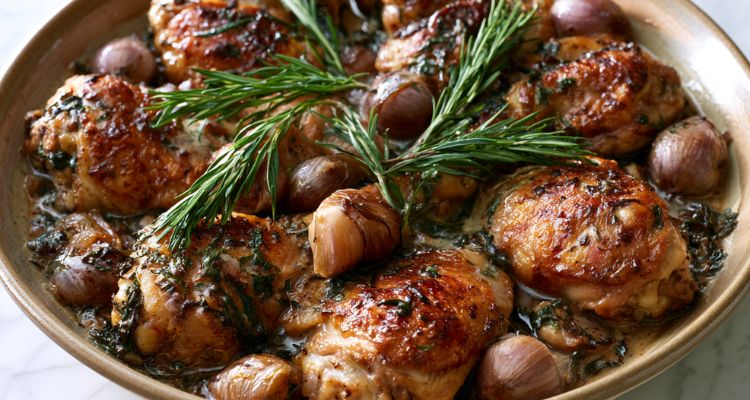
Delia Smith’s chicken with sherry vinegar and tarragon sauce is bone-in chicken simmered uncovered in sherry vinegar and Amontillado sherry for 45 minutes. It serves 4 at 835 calories per portion, finished with a spoonful of crème fraîche whisked into the reduced sauce.
The recipe comes from Delia’s Summer Collection (1993), and she calls it her adaptation of the French classic poulet au vinaigre. The Spanish twist is using sherry vinegar and Amontillado instead of the traditional wine vinegar.
The whole dish depends on cooking without a lid. Delia needs the liquid to evaporate so it reduces from over half a litre down to a glossy, concentrated sauce. Put a lid on and you’ll end up with thin, watery braising liquid instead.

Delia Smith Chicken With Sherry Vinegar
Course: DinnerCuisine: BritishDifficulty: Easy4
servings15
minutes45
minutes835
kcal1
hourDelia’s take on the French poulet au vinaigre, using Amontillado sherry and sherry vinegar to build a rich, tangy sauce. She suggests chilled Fino sherry as an apéritif alongside.
Ingredients
- For the chicken:
1 x 1.75 kg (3½ lb) chicken, jointed into 8 pieces, or 4 bone-in chicken breast portions
150 ml (5 fl oz) sherry vinegar
2 tablespoons fresh tarragon leaves
2 tablespoons olive oil
12 shallots, peeled and left whole
4 cloves garlic, peeled and left whole
425 ml (15 fl oz) medium-dry Amontillado sherry
1 heaped tablespoon crème fraîche
Salt and freshly milled black pepper
- To garnish:
8 small sprigs of fresh tarragon
- Equipment
A large, roomy frying pan, 23 cm (9 in) in diameter
Directions
- Brown the chicken: Heat the oil in the frying pan and season the chicken joints with salt and pepper. When the oil begins to shimmer, fry the chicken in two batches to brown well. Remove the first batch to a plate while you tackle the second. Each joint needs to be a lovely golden-brown colour.
- Brown the aromatics: When the second batch is ready, remove it to the plate to join the rest. Add the shallots to the pan, brown these a little, and finally add the garlic cloves to colour slightly.
- Simmer: Turn the heat down, return the chicken pieces to the pan, scatter the tarragon leaves all over, then pour in the vinegar and sherry. Let it all simmer for a bit, then turn the heat to a very low setting so that the whole thing barely bubbles, for 45 minutes.
- Turn halfway: Halfway through, turn the chicken pieces over to allow the other sides to sit in the sauce.
- Finish the sauce: When they’re ready, remove the chicken to a warm serving dish (right side up) along with the shallots and garlic. The sauce will by now have reduced and concentrated, so whisk the crème fraîche into it, taste and season as required, then pour the sauce all over the chicken and scatter with the sprigs of tarragon.
Notes
- Delia says this is lovely served with tiny new potatoes tossed in herbs and some fresh shelled peas.
- She also suggests well-chilled Fino sherry as an apéritif.
FAQs
Why does Delia use sherry vinegar instead of regular wine vinegar?
Sherry vinegar has a rounder, nuttier flavour than red or white wine vinegar because it’s aged in the same oak barrels used for sherry production. That depth pairs naturally with the Amontillado in the sauce, so the two ingredients reinforce each other rather than pulling in different directions.
Standard wine vinegar would work but the result tastes sharper and thinner. The Delia Online team confirms white wine works as a substitute for the sherry itself. You’d lose the warm, nutty character that makes this version distinctly Spanish rather than French, though.
Can I use chicken thighs instead of jointing a whole bird?
Delia gives two options in the recipe: a whole 1.75 kg chicken jointed into 8 pieces, or 4 bone-in chicken breast portions. Eight bone-in thighs are a practical third option because thigh meat stays juicier than breast over the 45-minute simmer.
Thigh meat stays juicier than breast because the bone and fat protect it during the long simmer. If you use boneless thighs, reduce the time to 30 minutes or the meat will fall apart. You’d also lose the clean presentation Delia’s after.
Why does Delia cook this without a lid?
The lid is the whole point of the recipe. Over 45 minutes, 575 ml of liquid needs to reduce down to just a few tablespoons of concentrated, glossy sauce. A lid traps the steam and prevents evaporation, so you’d end up with watery braising liquid instead of the sticky coating Delia describes.
This connects back to that browning step at the start. The fond left in the pan from searing the chicken dissolves into the sherry and vinegar, and as the liquid reduces, all that flavour concentrates. Covering the pan would dilute it rather than build it.
Can I make this dish ahead of time?
The Delia Online team advises doing all the prep ahead. Brown the chicken, shallots and garlic, cool everything, then store in a lidded container in the fridge. When you’re ready, return it to the pan with the vinegar and sherry and simmer fresh.
The sauce is best made fresh because the reduction happens in real time. Reheating a finished sauce thickens it further and can make the vinegar taste sharp again. stew with crusted dumplings is a better candidate for full make-ahead cooking because that broth improves overnight.
What does the crème fraîche do in the sauce?
Delia adds just one heaped tablespoon at the very end, after the liquid has already reduced. It’s not there to make the sauce creamy in the way a full cream sauce would be. The small amount rounds off the acidity from the vinegar and gives the sauce a slight gloss.
Whisking it in quickly is important because crème fraîche can split if heated too aggressively. The residual heat of the pan is enough to incorporate it smoothly. Soured cream works as a swap, and sausage and herb plait uses a similar technique of adding a dairy finish to a hot pan sauce.
What is the best sherry to use for cooking this?
Delia specifies medium-dry Amontillado, which sits between the bone-dry Fino and the sweet Oloroso. Amontillado has a nutty warmth that survives the 45-minute reduction without turning bitter or overly sweet. Cooking sherry from the supermarket is heavily salted and would throw off the seasoning completely.
You don’t need an expensive bottle, just a mid-range Amontillado around the price of a decent wine. Delia makes a clear distinction between cooking and drinking sherry, because she suggests chilled Fino alongside the meal. The Fino’s dryness cuts through the rich sauce.