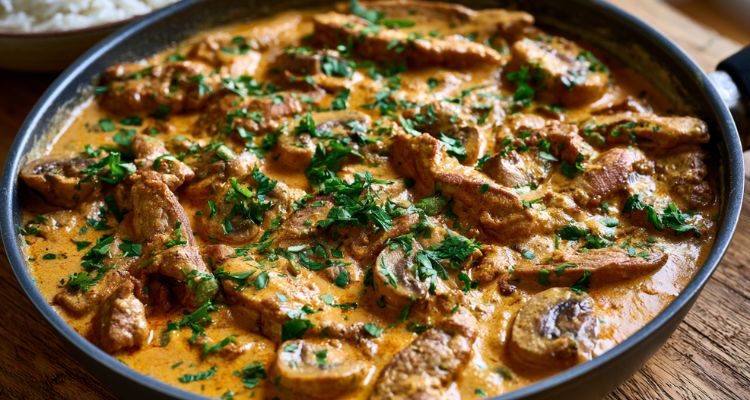
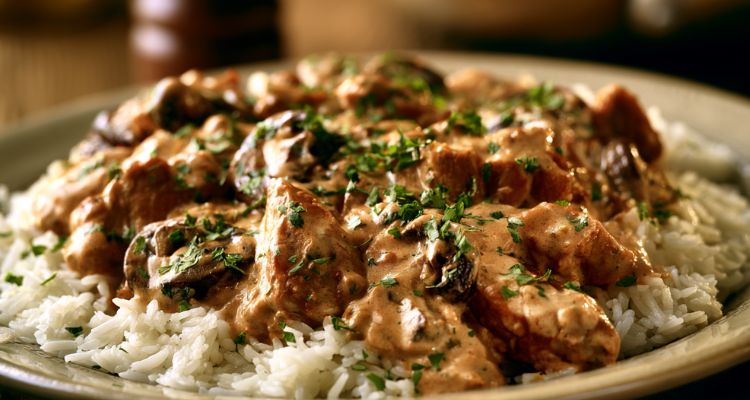
Mary Berry’s pork stroganoff is sliced pork fillet fried with mushrooms and paprika in a crème fraîche sauce, served with basmati rice. It serves four to six and cooks entirely on the hob in about 20 minutes.
Berry calls this “a classic recipe bound with a creamy sauce and flavoured with plenty of paprika” in Absolute Favourites (2015). She says she “often turn[s] to it if I am short of time as it can be quickly prepared on the hob.”
The crème fraîche goes in at the very end and should only “just bubble to heat through.” Berry finishes with lemon juice after the cream, which cuts through the richness without the reader quite noticing where the sharpness comes from.
Mary Berry Pork Stroganoff
Course: DinnerCuisine: BritishDifficulty: Easy4-6
servings10
minutes15
minutes320
kcal25
minutesBerry’s stovetop stroganoff from Absolute Favourites (2015), on the table in 20 minutes with no oven needed. Her most complete stroganoff recipe across all her books.
Ingredients
500g (1lb 2oz) pork fillet
2 tbsp sunflower oil
25g (1oz) butter
1 onion, finely sliced
3 tsp paprika
300g (11oz) button mushrooms, halved
200ml (7fl oz) full-fat crème fraîche or double cream
1 tbsp lemon juice
salt and freshly ground black pepper
1 tbsp chopped parsley, to garnish
Directions
- Remove and discard any membrane from the pork fillet. Cut the meat on the diagonal into 1 × 6cm (½ × 2½in) strips.
- Heat a large, non-stick frying pan until very hot and add the oil. Fry the meat quickly over the high heat for 3–4 minutes until golden and cooked through, taking care not to overcook. Lift out with a slotted spoon on to a plate.
- Add the butter to the pan, followed by the sliced onion. Fry for a minute, then lower the heat, cover with a lid and cook for about 10 minutes until the onion is really tender.
- Sprinkle in the paprika and stir in the mushrooms, then turn up the heat and toss for a minute.
- Add the pork to the pan with the crème fraîche, allowing to just bubble to heat through, then add the lemon juice and season with salt and pepper. Serve at once, garnished with the chopped parsley, with basmati rice alongside.
Notes
- Calories: Pork fillet (500g): 735. Sunflower oil (30ml): 270. Butter (25g): 179. Onion (150g): 60. Paprika (6g): 17. Mushrooms (300g): 66. Crème fraîche (200g): 600. Lemon juice: 3. Total: 1,930 ÷ 6 = 322 → rounded to 320 kcal per serving.
FAQs
What cut of pork does Berry use?
She uses pork fillet, also called tenderloin, which is the long, lean muscle that runs along the backbone. Berry’s first instruction is to “remove and discard any membrane” before slicing. That thin silvery skin tightens in a hot pan and makes the strips curl up.
Pork fillet cooks fast, which suits the stroganoff method perfectly. The strips only need 3–4 minutes over high heat. A shoulder or loin chop would need much longer cooking and a different technique entirely, so stick with fillet for this recipe.
Can I use chicken instead of pork?
Yes, the method works with chicken breast cut into the same size strips. Berry’s paprika chicken uses the same crème fraîche and paprika combination, so the flavour profile transfers directly. Fry the chicken strips for 3–4 minutes until golden.
The only difference is that chicken breast is leaner than pork fillet and can dry out faster. I’d pull the chicken from the pan a fraction earlier than Berry suggests for the pork. It finishes cooking when you add it back to the hot sauce.
Why does Berry use crème fraîche and not soured cream?
Her Beef Stroganoff in Cooking with Mary Berry (2016) uses soured cream, so both work in a stroganoff. Crème fraîche has higher fat content, which makes it more stable when you add it to a hot pan. Soured cream is thinner and curdles more easily if the heat climbs too high.
Berry’s own instruction for the soured cream version says to “stir in the sour cream and heat gently.” That tells you she knows soured cream needs more careful handling. I prefer crème fraîche for stroganoff because you can let it bubble without watching the temperature so closely.
Can I prepare pork stroganoff ahead?
Berry says “the ingredients can be prepared a couple of hours before serving and kept in the fridge.” That means slicing the pork, preparing the onion and mushrooms, and measuring the crème fraîche, but not cooking the dish in advance.
I’ve reheated leftover stroganoff the next day and it works, though the pork firms up slightly and the sauce thickens as it cools. Reheat gently on the hob, stirring often, and add a splash of cream to loosen the sauce. Don’t reboil hard or the crème fraîche will split.
Why does Berry add lemon juice at the end?
The lemon juice goes in after the crème fraîche and cuts through the richness of the sauce. Without it, the cream and paprika can taste flat and heavy. Berry adds just one tablespoon, which is enough sharpness to lift the dish without tasting lemony.
Her Beef Stroganoff doesn’t include lemon juice at all, which is part of why that version tastes richer and heavier. I add lemon to any stroganoff now, even when the recipe doesn’t call for it. It makes the whole plate feel lighter.
What’s the difference between Berry’s three stroganoffs?
This Pork Stroganoff is the most complete version: paprika, mushrooms, crème fraîche and lemon juice, all on the hob in one pan. Berry’s beef stroganoff is simpler with no paprika and no lemon, just soured cream stirred through at the end for a sharper, heavier sauce.
Her Mushroom Stroganoff in the same book is the most different of the three. It uses dried porcini, red peppers and artichoke hearts with a cornflour-thickened stock base instead of cream. Berry serves crème fraîche or yoghurt on the side rather than cooking it into the sauce.