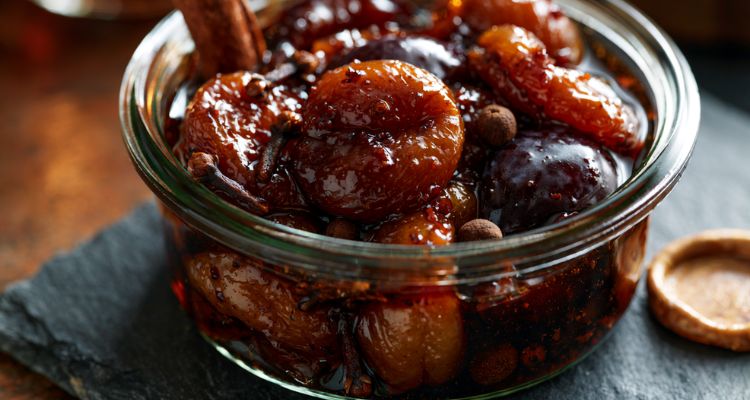
Delia Smith’s spiced pickled apricots are dried apricots and mi-cuit plums soaked in Lapsang Souchong tea, then packed in spiced vinegar with Armagnac. The recipe makes 5 jars and needs a month to mature. It comes from Delia’s Christmas Easy Magazine, 2003.
Delia has a companion recipe in Complete How to Cook using Agen prunes instead of apricots. Both follow the same method: tea soak, spiced vinegar, Armagnac in each jar. This version matures faster, needing one month before eating versus three for the prunes.
The Lapsang Souchong is the unusual step. Delia soaks the dried fruit in smoky tea for 3-4 hours before pickling. The tea rehydrates the apricots while adding a faint smokiness that sits behind the spice and vinegar without taking over.
Delia Smith Spiced Pickled Apricots
Course: Snacks, SidesCuisine: BritishDifficulty: Easy5
servings20
minutes15
minutes95
kcal35
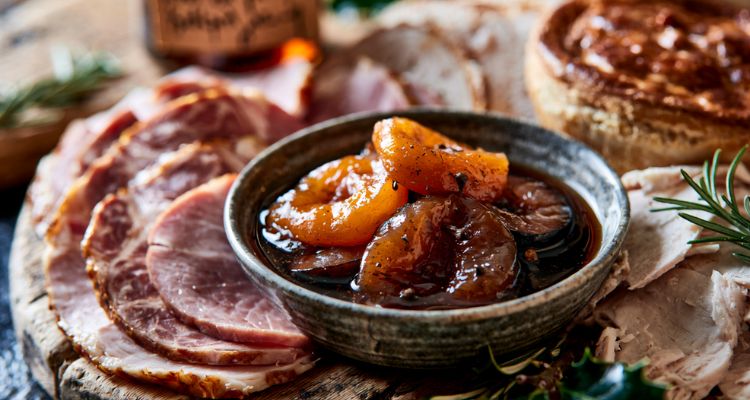
minutesFrom Delia’s Christmas Easy Magazine, 2003. Dried apricots and mi-cuit plums soaked in smoky tea, pickled in muscovado-spiced vinegar and finished with Armagnac. Delia says they make “a lovely accompaniment to cold cuts at Christmas.”
Ingredients
- For the tea soak:
1 tablespoon Lapsang Souchong tea leaves
1.2 litres (2 pints) boiling water
- For the fruit:
450g (1 lb) ready-to-eat dried apricots
450g (1 lb) mi-cuit plums, pitted
- For the pickling liquid:
570ml (1 pint) good-quality red wine vinegar
225g (8 oz) light muscovado sugar
6 cloves
2 blades mace
6 allspice berries
5 small cinnamon sticks
- For finishing:
5 tablespoons Armagnac
- Equipment
5 x 350ml (1 lb) capacity jars with vinegar-proof plastic lids
5 waxed discs
Directions
- Measure 1.2 litres of boiling water into a large jug. Stir in the Lapsang Souchong tea and leave to steep for 3 minutes.
- Put the apricots and plums into a large, non-metallic bowl. Strain the tea over the fruit, cover with a clean tea cloth and leave to soak for 3-4 hours.
- Put the vinegar, sugar and spices into a medium saucepan. Bring everything slowly to the boil and simmer gently for 15 minutes.
- While the vinegar simmers, sterilise the jars. Wash them in warm soapy water, rinse well and dry with a clean tea cloth. Place on a baking tray and put into the oven at 180C (350F), gas mark 4, for 5 minutes.
- Drain off the tea. Pack the apricots and plums into the hot, sterilised jars, adding a cinnamon stick to each jar and filling them as full as possible.
- Pour the hot pickling liquid over the fruit, swivelling each jar to make sure the fruit is covered.
- Spoon a tablespoon of Armagnac into each jar. Cover straightaway with a waxed disc and seal tightly.
- When the pickles are cold, label the jars and store in a cool, dark place for at least a month before eating.
Notes
- Maturing time: 1 month minimum
- Makes: 5 x 350ml jars
FAQs
What are mi-cuit plums and what can I use instead?
Mi-cuit means “half-cooked” in French. These are plums that have been partially dried, leaving them softer and juicier than a fully dried prune. Delia describes them as “sort of half-dried prunes but juicier.”
They can be hard to find in UK supermarkets. Delia’s own website suggests using ready-to-eat Agen prunes as a substitute. Regular pitted prunes work too, though they’re drier and will absorb more of the tea during soaking. If you use fully dried prunes, extend the soaking time to 5-6 hours so they plump up properly.
Why does Delia soak the fruit in Lapsang Souchong tea?
The tea does two jobs at once. First, it rehydrates the dried apricots and plums so they’re plump before going into the jars. Second, Lapsang Souchong is a smoked black tea, and that smokiness adds a subtle layer under the spice and vinegar.
Regular black tea would rehydrate the fruit but wouldn’t add any flavour. Plain water would work for soaking but leaves the fruit tasting flat. Delia chose Lapsang specifically for that smoky note, which pairs with the Armagnac and muscovado sugar. summer fruit compote takes the opposite approach, using no liquid at all and baking the fruit dry.
How long do these pickles need to mature before eating?
Delia says at least one month in a cool, dark place. During that time the vinegar softens the fruit further and the spices infuse through every piece. Eating them too early gives you sharp vinegar and flat fruit with no depth.
Her prune-only version in Complete How to Cook needs three months, because whole prunes are denser and take longer to absorb the pickling liquid. After a month, these apricots and plums have a balanced sweet-sour-smoky flavour. They keep for up to a year in sealed jars, getting better at around the 2-3 month mark.
Why does Delia use vinegar-proof lids?
Standard metal lids corrode when they touch vinegar. The acid eats through the coating and you get rust spots on the underside, which can drop into the pickle. Vinegar-proof lids have a plastic lining that resists the acid.
Delia also uses waxed discs pressed directly onto the surface of the liquid. This creates an airtight seal that stops air reaching the fruit. Without it, the top layer discolours and dries out. You can find vinegar-proof lids at kitchen shops or online. Kilner jars with rubber seals work too.
What can I serve these pickled apricots with?
Delia designed these for Christmas cold cuts. They sit perfectly alongside ham, turkey, pork pie or a cheese board. The sweet-sour flavour cuts through rich, fatty meats the same way cranberry sauce does, but with more complexity.
They also work with pate and crusty bread as a starter. A few apricots spooned alongside aubergines amalfitane would add a sharp contrast to the mozzarella. Outside of Christmas, try them with a simple ploughman’s lunch. The Armagnac gives them enough warmth to pair with strong cheddar or stilton.
Can I use brandy instead of Armagnac?
Brandy works, though the flavour is slightly different. Armagnac is distilled once, giving it a rougher, more complex character than cognac or standard brandy, which are double-distilled and smoother. That roughness pairs better with the vinegar and spice.
If you can’t find Armagnac, cognac is the closest substitute. Standard cooking brandy is fine but gives a flatter result. Calvados, the apple brandy from Normandy, would add a fruity note that clashes with the muscovado sugar. Stick with grape-based spirits. One tablespoon per jar is a small amount, so the quality shows. Cheap spirits taste harsh with nowhere to hide.